
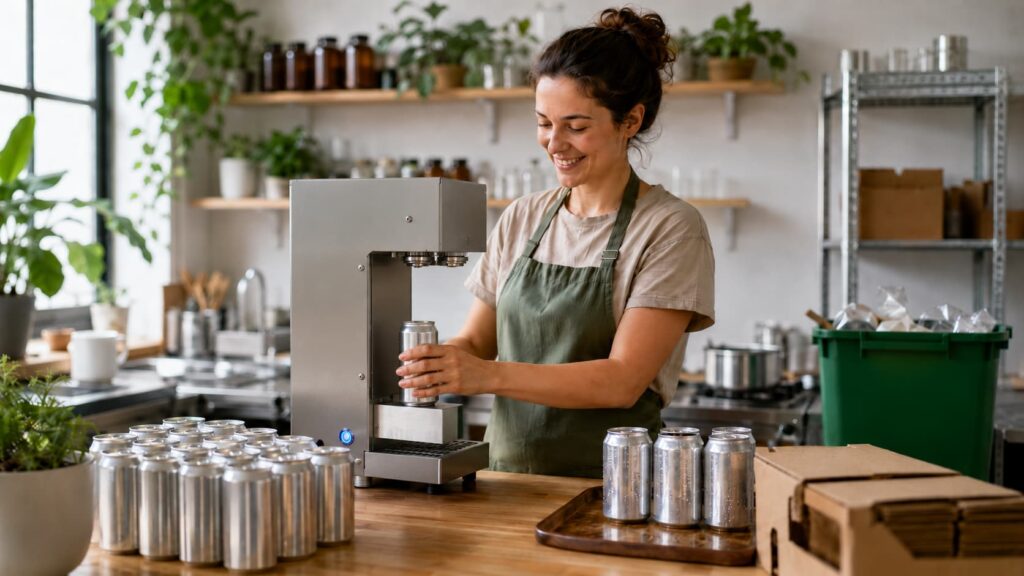
For a small food or beverage business, packaging is much more than a container. It protects the product, influences how customers perceive the brand and often determines whether the product can be sold through cafés, shops, delivery services or events.
However, choosing packaging is rarely simple. Plastic is inexpensive and widely available, but its environmental consequences are becoming increasingly difficult to ignore. Aluminum cans offer a more circular alternative, yet many small producers assume that professional canning requires a large factory, an automated production line and an investment they cannot afford.
That is no longer always the case. Compact filling and seaming technologies now allow cafés, microbreweries, restaurants, beverage startups and artisan producers to package small batches professionally without beginning with industrial-scale equipment. This gives entrepreneurs a practical way to reduce their dependence on plastic, protect product quality and grow at a pace that matches real demand.
The Real Cost of Plastic Packaging
Plastic has made modern packaging convenient, lightweight and inexpensive. At the same time, the way it is produced, used and discarded has created a serious global waste problem.
Plastic does not simply disappear after it is thrown away. It can remain in the environment for decades, gradually breaking into smaller fragments and microplastics. According to the United Nations Environment Programme, only a small proportion of the plastic produced worldwide is mechanically recycled, while large volumes are landfilled, burned, exported or released into natural environments. Under current patterns of production and consumption, the amount of plastic waste generated globally is expected to continue growing.
There is also a health and product-quality dimension that should be discussed carefully and responsibly.
It would not be scientifically accurate to claim that every plastic food package directly causes cancer. Food-grade plastics are regulated, and their safety depends on their composition and intended conditions of use. However, chemicals can migrate from food-contact materials into food or beverages. The level of migration can be affected by the type of material, the contents of the package, storage time and temperature.
This is why European food-contact regulations test packaging under defined time and temperature conditions. Packaging must not transfer substances in quantities that could endanger health or cause unacceptable changes to the composition, taste or smell of the product. Using plastic packaging outside its intended temperature range, particularly with hot products or during repeated temperature fluctuations, can therefore create avoidable concerns about chemical migration and sensory quality.
Reducing unnecessary plastic packaging is consequently not only about following a trend. It is part of building a cleaner, more responsible and more resilient production system.
Why Small Producers Find Sustainable Packaging Difficult
Large beverage companies can invest in automated filling lines, purchase packaging in enormous quantities and distribute production costs across millions of units.
A small producer works under very different conditions.
A local kombucha brand may need only a few hundred cans for a new flavour. A coffee shop may want to test ready-to-drink cold brew without committing to year-round production. A restaurant may need canned cocktails for takeaway orders, while a microbrewery may want to release limited seasonal batches.
Traditional industrial equipment is often unsuitable for these businesses because it can require:
- A substantial initial investment
- Permanent production space
- High minimum production volumes
- Specialised operators
- Complex cleaning and maintenance
- Large packaging orders
- Long-term commitment before demand is proven
Outsourcing canning is another option, but it may also involve minimum order quantities, transportation costs, scheduling limitations and less control over production.
As a result, small businesses often remain dependent on plastic bottles or other less suitable packaging—not because they do not care about sustainability, but because the alternatives appear financially inaccessible.
The most useful sustainable solution is therefore not simply the material with the best environmental reputation. It is the solution a small producer can realistically adopt, operate and maintain.
Aluminum Cans as a More Circular Alternative
No packaging material is completely free from environmental impact. Producing primary aluminum requires significant energy and resource extraction. Its main advantage appears later in its lifecycle.
Aluminum retains its material properties when recycled and can be returned to productive use repeatedly. Recycling existing aluminum also requires considerably less energy than producing new aluminum from raw materials. Unlike many plastic products, which can lose quality during recycling and are frequently downcycled into lower-value materials, recovered aluminum remains a valuable industrial resource.
Aluminum cans also offer practical advantages for food and beverage producers. They are lightweight, durable and efficient to transport. Properly filled and sealed cans provide a strong barrier against light and oxygen, helping protect flavour, aroma, carbonation and overall product quality.
For small brands, cans can also create a professional retail format. A canned product is easier to display, transport and distribute through takeaway refrigerators, local shops, events and delivery channels. The packaging surface provides space for branding, product information and a design that can help an independent product compete for attention.
Aluminum packaging is not automatically sustainable simply because it is recyclable. Its environmental value depends on responsible sourcing, efficient production, proper collection and access to local recycling systems. Nevertheless, when cans are correctly collected and recycled, they can support a much more circular use of materials.
Sustainable Packaging Without an Industrial Production Line
The development of compact canning equipment has changed what is possible for smaller producers.
Instead of beginning with a fully automated line, a business can start with equipment designed specifically for small batches. Production can remain manual or semi-manual while still delivering accurate filling and professional can seams.
This approach reduces financial risk because the business can:
- Test a product before investing in large-scale production
- Produce according to actual demand
- Launch seasonal or limited-edition products
- Avoid excessive packaging inventory
- Maintain direct control over filling and sealing
- Expand production gradually as sales increase
- Reduce product loss during packaging
Green Canning supports this practical approach to sustainability. Environmental responsibility should not be limited to corporations with large budgets. Small businesses, local producers and entrepreneurs also need access to technologies that help them reduce waste while building economically viable products.
One example comes from our partner, Eazy Canning, which develops compact filling and seaming solutions for small and medium-sized producers.
iKAN Makes Professional Can Seaming More Accessible
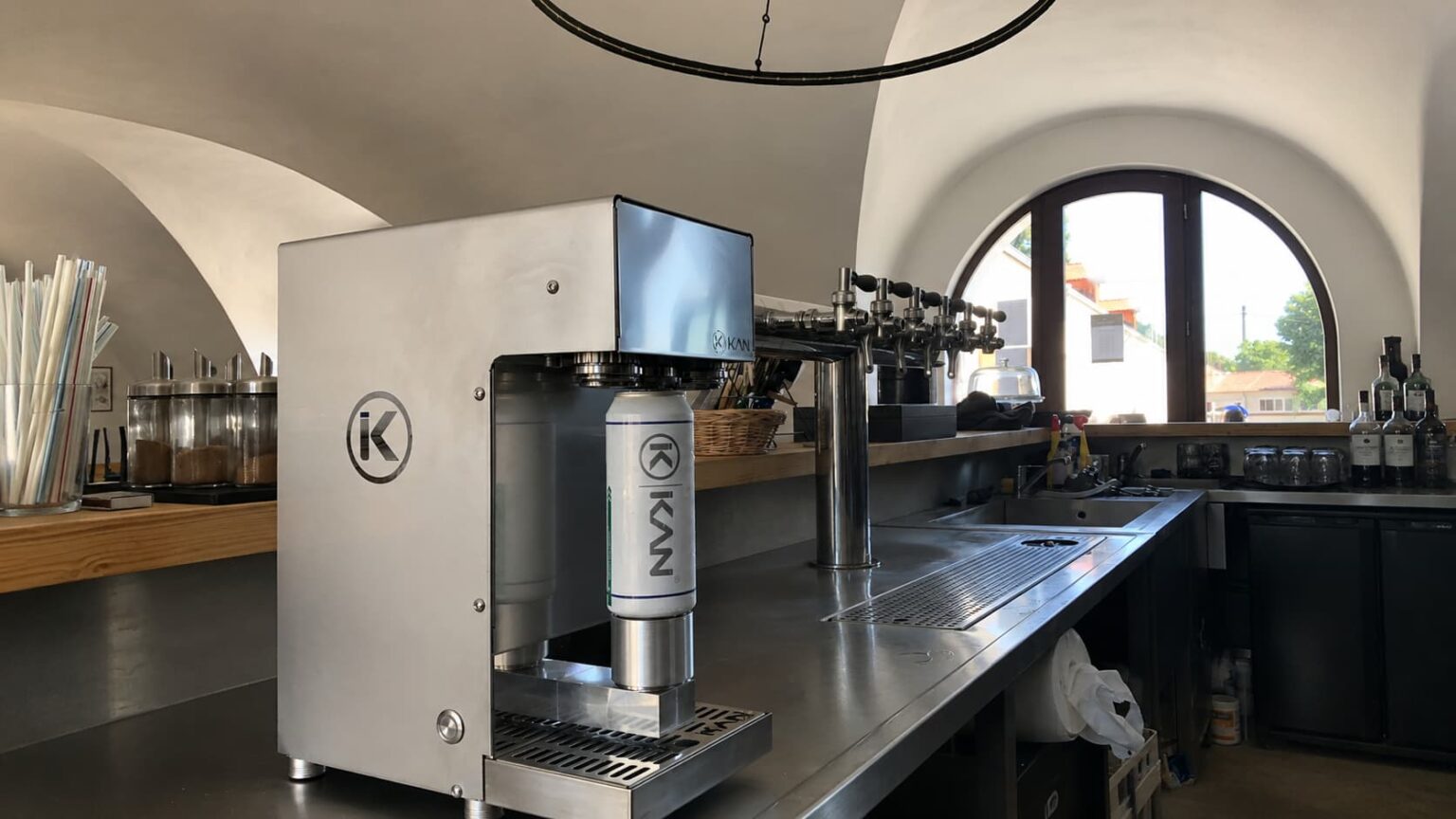
The iKAN Can Seaming Machine is designed for small-batch beverage and food production. It provides a professional double seam without requiring a large automated canning system.
Its compact tabletop format makes it suitable for coffee shops, restaurants, microbreweries, shared kitchens, beverage laboratories and small production spaces. The machine weighs 18 kilograms and measures only 44 × 18 × 35 centimetres, so it can be installed without permanently reorganising an entire facility.
Despite its small footprint, iKAN can seam up to 10 cans per minute. It supports can volumes from approximately 200 ml to 1,000 ml, giving producers the flexibility to test different serving formats and product categories. The machine is built using food-grade stainless steel and aluminum and is designed for straightforward installation and operation.
For a small producer, this flexibility is important. A business can use the same compact machine for products such as:
- Craft beer
- Cold brew and nitro coffee
- Kombucha
- Sparkling drinks
- Energy drinks
- Ready-to-drink cocktails
- Selected liquid or prepared food products
The iKAN allows these businesses to bring seaming in-house rather than relying entirely on an external packaging company. This provides greater control over batch sizes, production schedules and final packaging quality.
The investment is also far below the cost of a large industrial canning line. At the time of writing, the listed purchase price is €3,280, with leasing options starting from €100 per month over a 36-month period, depending on the business and applicable conditions. This creates a much more realistic entry point for entrepreneurs who want to begin with manageable costs.
FENIX Brings Controlled Filling to Small-Batch Production
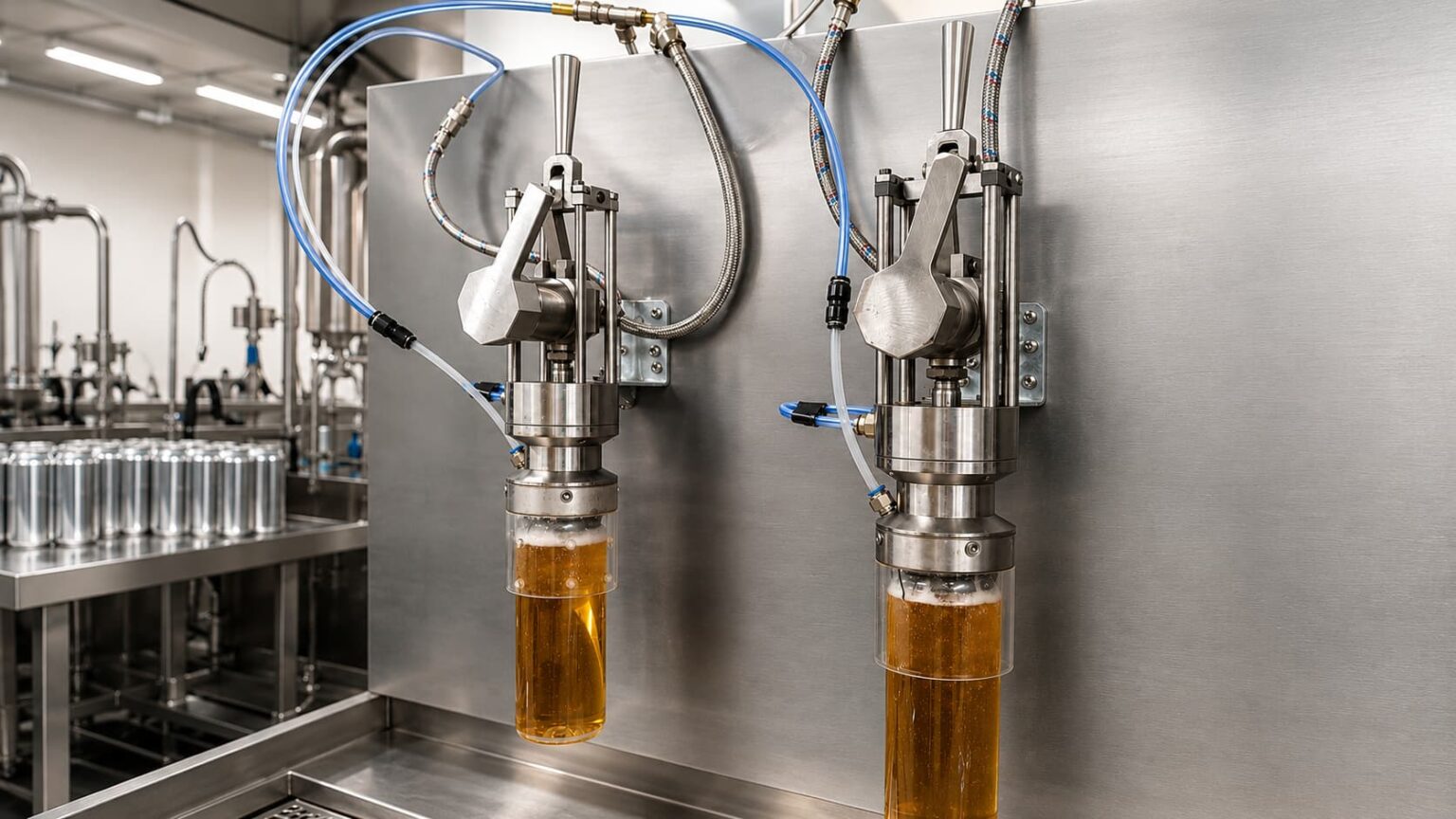
Seaming is only one part of the packaging process. Before a can is closed, it must be filled accurately and with minimal unnecessary product loss.
The FENIX Beverage Can Filling Head is a compact manual counter-pressure filling solution developed for carbonated drinks. It uses a specialised clamping system to hold and seal the can during filling and can operate at pressures of up to four bars.
Counter-pressure filling helps control foaming and reduce product loss, which is particularly important for craft beer, cider, kombucha, sparkling tea, nitro coffee and canned cocktails. It can also help limit unnecessary oxygen exposure during the filling process, supporting the quality of sensitive beverages.
Each FENIX head can fill approximately three to four cans per minute. A dual-head configuration can reach a production capacity of around 100–150 cans per hour. The unit weighs only 4.3 kilograms, is made from food-grade stainless steel and is compatible with Clean-In-Place procedures for more efficient hygiene management.
For a small business, the value of FENIX is not simply speed. It provides greater consistency than uncontrolled hand filling while avoiding the cost and complexity of full automation.
This creates a useful middle ground between filling every can with basic tools and purchasing machinery designed for mass production.
A Complete Compact Canning Workflow
FENIX and iKAN can be used together to create a compact small-batch canning line. First, the product is filled into an aluminum can using the FENIX counter-pressure filling head. The operator then places a lid on the filled can and transfers it to the iKAN. The seamer creates a professional double seam that closes the can securely.
This simple workflow allows a small producer to manage both major packaging stages in-house:
- Controlled filling
- Immediate placement of the can lid
- Professional double-seam closure
The business can begin with one filling head and a single seamer, learn from customer demand and expand its production capacity later. It does not need to build tomorrow’s factory before selling today’s product.
Better Packaging Can Reduce Business Risk
For a small producer, sustainability and financial responsibility should support each other. Producing small batches reduces the risk of unsold inventory. Better control over filling can decrease spills and product loss. A reliable seam can help prevent leaks, damaged stock and disappointed customers. Compact equipment requires less space, and flexible production makes it easier to experiment with new recipes, sizes and markets.
Professional cans can also open new sales opportunities. A café can place its cold brew in local grocery shops. A brewery can introduce takeaway cans and seasonal releases. A restaurant can prepare branded cocktails for delivery. A beverage startup can present samples to retailers without ordering tens of thousands of units.
This is what practical sustainable innovation looks like: not forcing a small company to operate like a multinational corporation, but giving it the tools to produce responsibly at its own scale.
Connecting Sustainable Ideas with Practical Solutions
At Green Canning, we believe that protecting the environment requires more than raising awareness. Entrepreneurs and communities need practical tools, reliable information and access to partners who can help turn sustainable ideas into working solutions.
Our role is to support a future in which environmental responsibility and economic opportunity grow together. By encouraging canning, recycling, material reuse and accessible production technologies, we help smaller businesses participate in the transition toward a circular economy.
Eazy Canning is one of the partners demonstrating how this transition can work in practice. Its compact iKAN and FENIX equipment allows small and medium-sized producers to consider professional aluminum packaging without immediately investing in an industrial canning line.
Businesses can begin with manageable production, learn from the market and expand when they are ready—all while reducing unnecessary plastic use and delivering a high-quality product.
If you are developing a sustainable packaging idea, looking for practical canning technology or creating a solution that could help businesses reduce waste, visit the Green Canning Partners page. There you can learn more about organisations working to make sustainable production more accessible and explore opportunities to collaborate with us.
Meaningful environmental change does not always begin with the largest investment. Sometimes it begins with a small producer, a better packaging decision and the right technology to put that decision into practice.